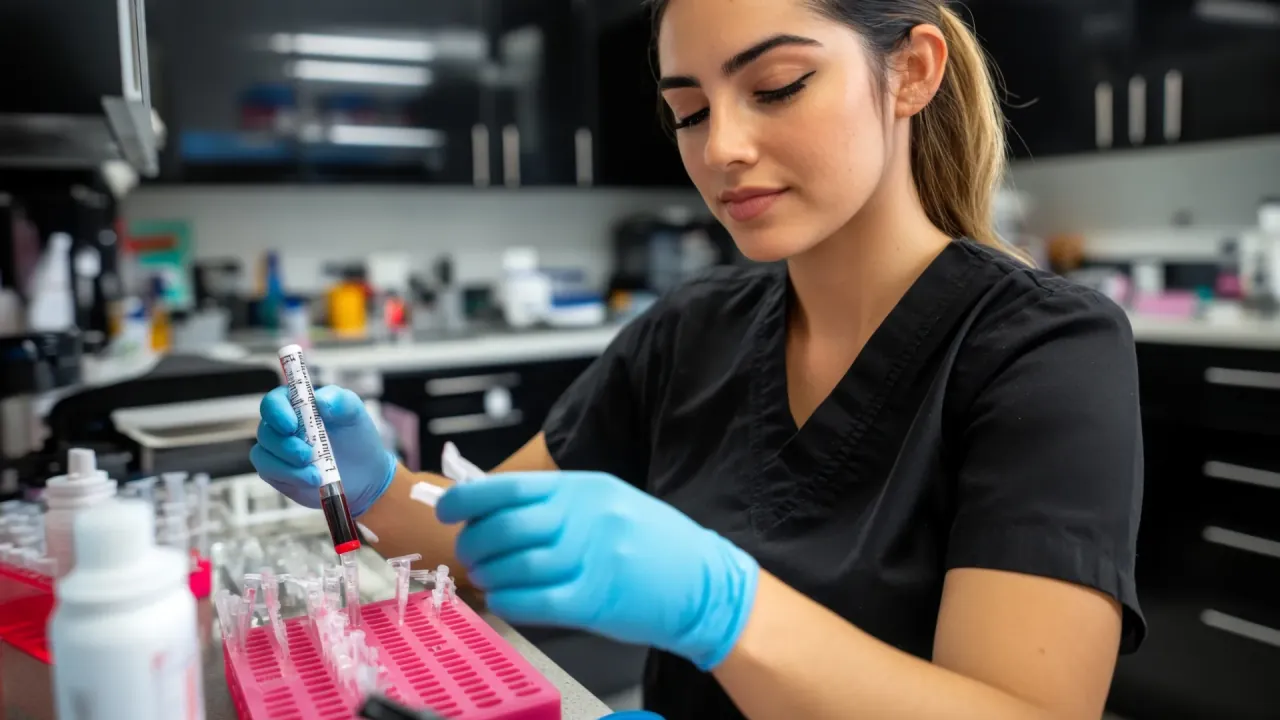
If you're steady with your hands, calm with people, and curious about what happens in a medical lab, this could be your lane. Phlebotomists draw blood, EKG technicians record how the heart is working, and lab assistants help handle and test samples.
Houston Career Institute's Laboratory Assistant/EKG Technician/Phlebotomist program trains you in all three. Here's what you learn and which national exams graduates are eligible to sit for.
Three skill sets in one program
Instead of training for just one thing, this program covers:
- Phlebotomy: drawing blood safely, the "order of draw," patient ID, consent, and privacy
- EKG: how the EKG process works and how to read basic EKG strips
- Lab assisting: handling specimens, using a microscope and centrifuge, urinalysis, and common lab tests
You also learn to take vital signs and get CPR certified.
What you learn, module by module
The program starts with an Introduction to the Healthcare Profession course covering medical terms, anatomy, infection control, HIPAA, OSHA, computer skills, and CPR.
Then you move through seven modules, each with lecture and hands on lab practice under an instructor:
- Module A: lab safety, infection control, handling body fluids and specimens, and using the microscope and centrifuge
- Module B: blood and its parts, red and white blood cell tests, and routine urinalysis
- Module C: the heart and lungs, the EKG process, and reading basic EKG strips and heart rhythms
- Module D: serum vs. plasma, glucose and lipid tests, and the endocrine and digestive systems
- Module E: the nervous system, drug testing, specimen chain of custody, and working well with patients
- Module F: phlebotomy, informed consent, patient privacy, the order of draw, and blood types
- Module G: body planes and cavities, and the muscles, bones, and nervous system
After the modules, you finish with an externship at an approved site.
How long is phlebotomy and EKG school at HCI?
You can finish in as few as 9 months, and that includes the externship. HCI offers morning and evening classes, so ask admissions which one is open for your start date.
Phlebotomy and EKG certification
HCI graduates are eligible to sit for two national exams from the National Center for Competency Testing (NCCT):
- National Certified ECG Technician (NCET)
- National Certified Phlebotomy Technician (NCPT)
That means one program can help you work toward both an EKG credential and a phlebotomy credential.
What is the externship like?
The externship puts your skills to work in a real setting, with staff at the site supervising you. It's where you practice blood draws and skin punctures on real patients.
Good to know:
- It's part of your training, so you take part as a student and it's unpaid.
- Externship sites require a background check and drug test.
- Hours can change based on the site's schedule.
- It's a learning experience, not a job offer, but it's a great way to build real world skills.
What jobs could you look into after the program?
Entry level job titles graduates may want to look into include EKG Technician, Laboratory Assistant, Phlebotomist, Specimen Processor, and Lab Aide.
HCI's Career Services Office is there to help graduates look for entry level opportunities in their field. Employment isn't guaranteed, but you won't be figuring it out alone.
How much does phlebotomy school cost?
Tuition and fees are listed in the student catalog on HCI's consumer information page.
Financial aid is available for those who qualify, and the financial aid team can go over your options.
FAQ
How long is phlebotomy school at HCI?
In as few as 9 months, including the externship. The program covers phlebotomy, EKG, and lab assisting together.
Which certification exams can I take?
Graduates are eligible to sit for the NCCT National Certified ECG Technician (NCET) and National Certified Phlebotomy Technician (NCPT) exams.
Is HCI's EKG program accredited?
Houston Career Institute is accredited by the Accrediting Commission of Career Schools and Colleges (ACCSC).
Will I practice real blood draws?
Yes. You practice in the lab under an instructor, then do blood draws and skin punctures during the externship.
Can I take classes in the evening?
HCI offers morning and evening classes. Ask admissions what's open for your start date.
Is the externship paid?
The externship is part of your training, so it's unpaid. You take part as a student.
Come see the lab
Houston Career Institute is at 9700 Bissonnet Street in Houston, close to Sharpstown, Gulfton, Bellaire, and Alief.
Request info or schedule a campus tour, and an admissions rep can go over start dates, class times, admissions requirements, and financial aid for those who qualify.
Houston Career Institute is accredited by the Accrediting Commission of Career Schools and Colleges (ACCSC). Career services assistance is available to students and graduates; employment is not guaranteed.